














Printing in the Ottoman Empire: An Analysis of Transformation from the Calligrapher's Pen to the Printing Press
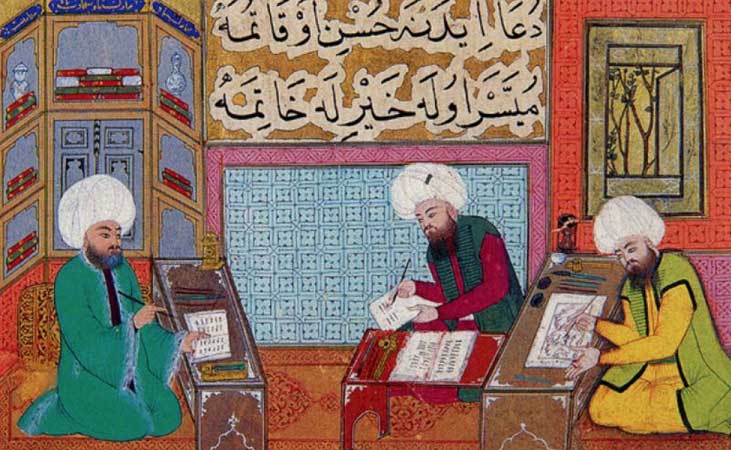
The history of information technology in the Ottoman Empire is a multi-layered story of technological adaptation that bears striking parallels to the digital transformation we are living through today. When the revolution initiated by Johannes Gutenberg with movable metal type in fifteenth-century Europe reached Ottoman lands, it did not merely bring a machine — it brought with it the unraveling of an entrenched economic order, an artistic tradition, and a monopoly over knowledge. Viewed through the lens of a technology analyst, the entry and development of the printing press in the Ottoman Empire represents one of the clearest historical manifestations of 'disruptive innovation.' This article examines, in depth, the technical, economic and sociological dynamics of the transition from the analog era of manual knowledge reproduction to the age of industrial print.
The Information Factories of the Analog Age: Ehl-i Hiref and the Manuscript Economy
Before printing technology entered the Ottoman mainstream, the production and distribution of knowledge was an entirely human-labor-intensive, costly and artistically meaningful 'analog' process. At the center of this ecosystem stood the 'Ehl-i Hiref-i Hassa' organization, structured within the imperial palace. Ehl-i Hiref — meaning 'people of craft' — was a professional production organization of artisans and craftsmen attached to the palace. This structure functioned as a quality-control mechanism that set the standards for Ottoman art and technology. Scribes, calligraphers, copyists, miniaturists and bookbinders worked in synchronized fashion throughout the process of transforming knowledge into a physical object.
The organization's hierarchy was built on strict professionalism rooted in master-apprentice relationships. Newly recruited 'shakirds' began at low wages, while masters who had attained the titles of 'sersanatkar' or 'kethüda' through seniority drew high salaries and shaped the aesthetic language of the court. Although this system guaranteed the accuracy and aesthetic quality of knowledge, it limited the speed of knowledge dissemination to the speed of an individual's handwriting. Reaching the peak of its power in the sixteenth century, the organization had transformed into a colossal knowledge production center, bolstered by talented artists brought from the East following the conquests of Selim I and Suleiman the Magnificent.
| Occupational Group | Functional Definition | Economic Impact and Status |
|---|---|---|
| Hattat (Calligrapher) | Aesthetic and artistic production of writing | High status, limited production capacity |
| Müstensih (Copyist) | Manual copying of books; serial reproduction | Middle class, broad employment base |
| Kâtip (Scribe) | Recording official documents and correspondence | Center of bureaucracy, strategic importance |
| Nakkaş (Miniaturist) | Illustrating books with miniatures and paintings | Specialist expertise adding artistic value |
| Müccellit (Bookbinder) | Binding and physical protection of books | Final link in the artisan chain |
Early Technology Adopters: Minority Printing Houses (1493–1727)
The first users of printing technology in the Ottoman state were the Jewish, Armenian and Greek communities, who closely followed developments in Europe and their own communal needs. These communities imported this 'new media' technology long before the Ottoman mainstream. In 1493, Sephardic Jews who had fled Spain brought the printing press to Istanbul. The first printing house, established by the Nahmias brothers, produced 'Arba'ah Turim' (Four Rows), the first printed work on Ottoman soil. Behind the Jewish community's early adoption lay both the desire to preserve religious texts and their access to European technical networks.
At a time when the printing press was being used in Christian Europe as a tool of threat or censorship by the Church, the Ottoman state displayed a remarkably tolerant attitude toward these minority printing houses. Istanbul rapidly became a global center of Hebrew printing. Yet this tolerance came with an important technical restriction: printing could only be carried out in Hebrew or Latin; printing in the Arabic script used by the Muslim population was not permitted. The Armenian community established its own printing house in 1567, and the Greek community followed in 1627. It is estimated that around 37 minority printing houses operated on Ottoman territory between the 15th and 18th centuries.
| Community | First Established | Primary Purpose | Key Centers |
|---|---|---|---|
| Jewish (Sephardic) | 1493 | Preservation and dissemination of religious and legal texts | Istanbul, Thessaloniki, Izmir |
| Armenian | 1567 | Educational materials and building communal consciousness | Istanbul |
| Greek | 1627 | Religious advocacy and production of educational material | Istanbul |
| Muslim (Ottoman) | 1727 | Standardization and dissemination of secular knowledge | Istanbul (Dârü't-Tıbâa) |
Ibrahim Müteferrika and the Strategic Foundations of the Muslim Printing House
The full adoption of printing technology by the Muslim population came about in the reformist atmosphere of the Tulip Era in the early 18th century. The most important figure in this process was Ibrahim Müteferrika — not merely a printer, but a technology evangelist and strategist. In 1726, Müteferrika presented a report titled 'Vesiletü't-Tıbaa' (The Means of Printing) to Grand Vizier Nevşehirli Damat Ibrahim Pasha, setting out ten technical and sociological justifications for establishing the press. The report reads as a modern 'business plan,' addressing everything from reducing the cost of knowledge production to ensuring data integrity.
- Accuracy and Standardization: Eliminating copyist errors in manuscripts by printing from primary sources.
- Knowledge Security and Archiving: Multiplying rare works to protect libraries from disasters such as fire and war.
- Cost and Accessibility: Lowering book prices so scholars and students can access knowledge cheaply.
- Cultural Soft Power: Producing the most accurate and aesthetic editions in Istanbul, replacing error-filled European copies of Eastern texts.
- Strategic Knowledge Production: Supporting decision-making by printing history and geography books for statesmen and military commanders.
- Promotion of Learning: Making it easier for new generations to dedicate themselves to scholarship.
- Economic Benefit: Strengthening artisan and merchant classes through the growth of the book trade.
- Linguistic Unity: Fixing spelling standards through print to preserve linguistic integrity.
- Military and Technical Knowledge: Rapidly disseminating knowledge in engineering, medicine and artillery.
- Ottoman Prestige: Establishing Istanbul as the most accurate and reliable source of knowledge in the Islamic world.
The fatwa obtained for the establishment of the printing press is the product of a strategy for controlled and gradual integration of technology into the system. Religious texts were left to the calligraphers, while secular knowledge was entrusted to the speed of the machine.
— From the History of Ottoman Printing
The greatest obstacles Müteferrika faced in bringing this 'disruptive' technology to life were the traditional knowledge-producing classes and religious reservations. To overcome these obstacles, he obtained a fatwa from Şeyhülislâm Yenişehirli Abdullah Efendi stating 'there is no objection to the printing of non-religious works,' along with an official edict from Sultan Ahmed III. This fatwa restricted the scope of the press to history, geography, medicine and dictionary works, requiring that the Quran, hadith and fiqh continue to be reproduced by hand in the calligraphic tradition.
Technical Infrastructure: Dârü't-Tıbâa and the First Publications
The 'Dârü't-Tıbâa' established in Müteferrika's home in 1727 can be considered the Ottoman Empire's first indigenous technology venture. A serious process of technology transfer and localization was undertaken during the press's setup. Although the machines and Latin-character molds were imported from abroad, the casting of metal type compatible with the Arabic script was an engineering challenge Müteferrika worked on personally. Recognizing the importance of raw-material independence for a technology ecosystem's sustainability, he established a paper factory in Yalova in 1744 to achieve vertical integration. The press's first work was the 'Vankulu Dictionary,' printed in 1729 — an Arabic-Turkish dictionary printed in one thousand copies that achieved great success. Over his lifetime, Müteferrika printed a total of 17 works, with a combined print run of 9,700 copies, more than 70 percent of which are known to have been sold.
| Title | Type | Year | Notable Feature |
|---|---|---|---|
| Vankulu Dictionary | Dictionary | 1729 | First product of the press; Arabic-Turkish, 1,000 copies |
| Tarih-i Hind-i Garbi | Geography | 1730 | First illustrated and mapped printed work |
| Cihannüma | Geography | 1732 | Masterwork of Kâtip Çelebi; pioneer of modern cartography |
| Usulü'l-Hikem | Politics / Critique | 1732 | Müteferrika's work of social critique and reform |
| Tarih-i Seyyah | History | 1729 | Travel narrative documenting Ottoman geography |
The Calligraphers' Resistance: Economic Protectionism and Aesthetic Opposition
The arrival of the printing press represented a direct employment crisis for the thousands of calligraphers and copyists in Istanbul. Although this group's stance against the press has often been reduced to mere 'bigotry,' it actually rested on far deeper economic and professional grounds. A Gutenberg press could produce hundreds of copies of a text in a few days that a calligrapher would spend months writing. For these artisans tied to the guild system, this spelled 'professional death.' The situation generated social tension paralleling the Luddite movement — in which textile workers in 19th-century England smashed machines — with artisans fearing that market saturation would destroy the value of their hand-produced work.
Calligraphers also articulated powerful aesthetic and spiritual arguments. They maintained that writing was not merely a means of conveying data but a form of art and worship. It was believed that each letter of a handwritten Quran or jurisprudence book contained a fragment of the calligrapher's soul. The 'mechanical' and 'cold' production of the press was characterized as a process that damaged the spirit of sacred knowledge. Moreover, the failure of movable type to replicate the flowing ligature structure of Arabic script provided a concrete technical ground for aesthetic rejection. The Ottoman administration responded with a masterly balancing act: by prohibiting the printing of religious books in the 1727 edict, it left the calligraphers' most profitable domain intact while restricting the press to secular knowledge.
The 19th Century: Industrialization of Print and the Lithography Revolution
The process that began with Müteferrika in the 18th century reached a mass scale in the 19th century with the Tanzimat reforms and technical innovations. The most significant technological breakthrough of this era was 'stone printing' — lithography — brought to the Ottoman Empire by Henri Cayol. Lithography softened the sharp boundary between calligraphy and typography, functioning as a bridge technology: a calligrapher could transfer his own handwriting to a stone, from which thousands of copies could be reproduced. This method offered calligraphers the opportunity to reach thousands of people with their art without compromising aesthetics, serving as an 'intermediate technology' capable of mass production. Private publishing flourished under the Tanzimat, and the number of periodicals such as newspapers and journals grew rapidly. It is estimated that between 25,554 and 30,000 Turkish books were printed between 1729 and 1928.
| Period | State of Printing | Main Trend |
|---|---|---|
| 1727–1745 | 1 press (Müteferrika) | Pioneer and experimental era; 17 works, 9,700 copies |
| 1789–1830 | State monopoly (Engineering School) | Military and technical printing; army modernization |
| 1831–1928 | Private publishing and press freedom | Journalism, lithography and Tanzimat revolution |
| 1928–present | Latin script after the Alphabet Reform | Mass literacy and modern publishing |
Literacy rates in the late Ottoman period remain a major controversy among historians. Figures of 54 to 66 percent literacy presented by scholars such as Kemal Karpat on the basis of 1894 data have been criticized by modern researchers as 'wrong mathematics built on bad data.' The first census of 1927 showed that the literacy rate across Turkey in Arabic script was only 8.61 percent. This figure reveals that despite the technical existence of the printing press, barriers to the broad dissemination of knowledge across society — expensive paper, an inadequate education system — persisted.
The Print Revolution and Digital Transformation: A Historical Analogy
To understand how artificial intelligence and digital platforms are transforming knowledge production today, it suffices to look at 18th-century Ottoman printing history. Both revolutions shook cognitive and social structures by transforming the 'physical' form of knowledge. The printing press replaced the 'spatial memory' offered by manuscripts — remembering where on a page something was written — with standardized page numbers and indexes. Today, digital screens have eliminated the page entirely, introducing 'scrolling' and fluid knowledge consumption. Müteferrika's complaint about copyist errors is the historical equivalent of today's debates about fake news and data pollution. The calligraphers' aesthetic resistance to the press precisely mirrors contemporary criticism of the 'soullessness' of digital art and AI-generated works.
Historical Analogy
The calligraphers' aesthetic resistance to the printing press precisely mirrors contemporary criticism of the 'soullessness' of digital art and AI-generated works. In both cases, a generation argued that a machine could never substitute for human labor and spirit.
Conclusion: The Ottoman Model of Technological Adaptation
The story of the printing press in the Ottoman Empire demonstrates, beyond the mere 'invention' of a technology, how critical processes of social acceptance and adaptation truly are. The fact that although the press arrived in 1493, it did not spread among the mainstream Muslim population until 1727, stemmed not from technical inadequacy but from concern for preserving socio-economic balances — the calligraphers' guilds, the religious authorities. Müteferrika's success lay not simply in bringing the technology, but in presenting it within a 'business model' and 'legal framework' — the Vesiletü't-Tıbaa and the fatwas — compatible with the Ottoman system. The press did not entirely displace the calligraphers; instead, it created a hybrid knowledge ecosystem that lasted into the 19th century. This historical process teaches us that for technology to trigger social change, not only the machines but also the legal, economic and cultural institutions to give those machines meaning must be ready.
