








Offset or Digital? The Cost Crossover Point by Quantity
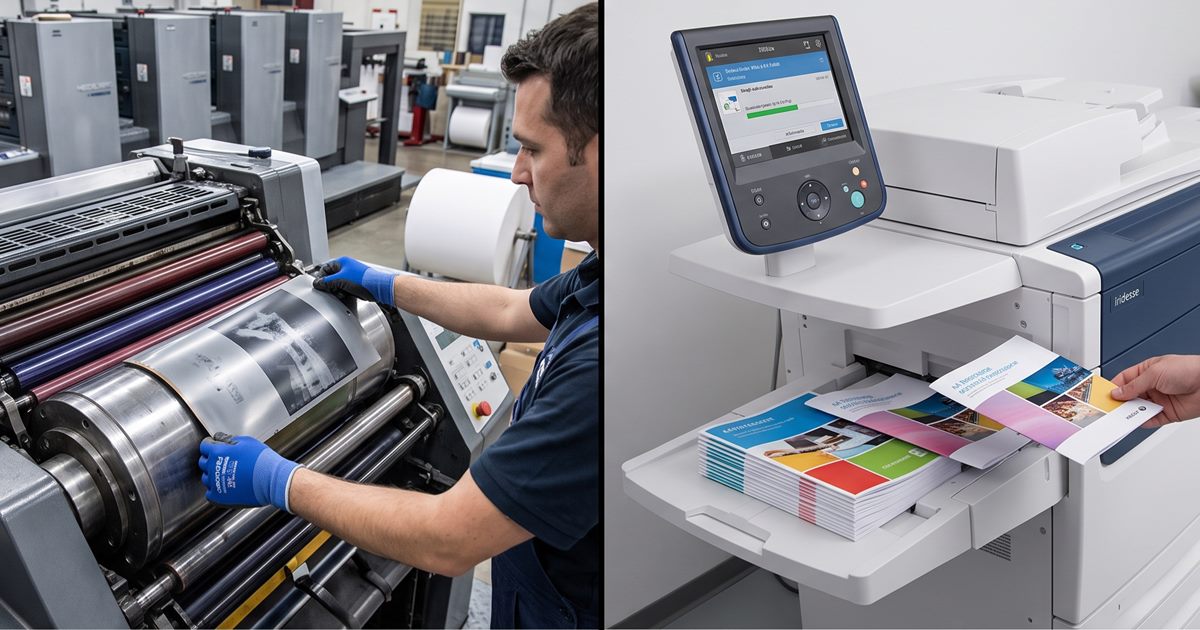
Same artwork, same paper, same size. Only the quantity changes, and the right answer reverses with it: at 200 copies digital wins comfortably, while at 5,000 offset pulls so far ahead that the comparison stops being interesting. This has nothing to do with one method being better than the other; it has to do with their costs arising in completely different places. With offset you pay before the job starts, with digital you pay per copy. This guide explains where that difference comes from, where the two curves cross, and what decides the question apart from price.
Why the Two Methods Cost Money in Different Places
Offset printing puts a run of preparation before the job reaches the press: a separate plate is imaged for each colour, the plates are mounted, the ink and water balance is established, and several hundred sheets are wasted until the colour settles. The total cost of that work is roughly the same whether you are printing 100 copies or 10,000. Once the press is running, however, it produces thousands of sheets an hour and each additional sheet costs little beyond the paper and the ink on it.
Digital printing has none of that preparation. There is no plate, there are no make-ready sheets, the file goes straight to the machine. In exchange, every page carries its own cost, and that cost does not fall as the run grows: the tenth copy and the thousandth cost the machine the same. The unit price of digital is therefore close to flat, while the offset curve starts very high and drops away quickly.
| Item | Offset | Digital |
|---|---|---|
| Plates | One plate per colour, a fixed cost | None |
| Make-ready | Ink and water balance, colour setting, waste sheets | Negligible |
| Cost of one more copy | Very low; paper and ink | Constant; every copy costs the same |
| Unit price as quantity rises | Falls quickly | Stays almost flat |
| Cost repeated on a reprint | Make-ready is done again | None, the file is simply resent |
| Centre of gravity of the cost | At the start of the job | In every copy |
How the Crossover Point Is Calculated
In offset the unit cost has two parts: the share of the fixed make-ready cost divided across the run, plus the variable cost of each copy. Call the fixed cost F, the offset variable cost per copy v, and the quantity n, and the offset unit cost becomes F/n + v. The digital unit cost is effectively constant; call it d. The quantity at which the two are equal follows from F/n + v = d, which gives n = F / (d − v). In other words, the crossover point is the make-ready cost divided by the gap between the digital and offset per-copy costs. The formula requires d to be greater than v, which under normal conditions it is.
| Quantity | Fixed cost per copy | Against the previous step |
|---|---|---|
| 100 | F / 100 | — |
| 500 | F / 500 | 80% lower |
| 1,000 | F / 1,000 | 50% lower |
| 3,000 | F / 3,000 | 67% lower |
| 10,000 | F / 10,000 | 70% lower |
The crossover point is not a single number
All three variables in the formula change from job to job. More colours mean more plates and a larger F; more expensive paper raises v and d together and narrows the gap; a larger format changes how many pieces fit on a sheet and moves both at once. There is therefore no universal threshold at which "offset becomes cheaper" — the crossover sits in a different place for every combination of product, size, colour and weight.
Why the Minimum Quantities Are Set Where They Are
At online printers, digital typically starts at 100 copies and offset at 1,000; on products such as books a single digital copy is possible. Those thresholds are not a marketing choice but a direct consequence of the cost structure above. A 200-copy job can be printed on an offset press without difficulty, but once the make-ready is divided by 200 the resulting unit price stops being something you can reasonably offer a customer.
- Make-ready cannot be divided: imaging plates and setting up the press take the same work whatever the quantity.
- Waste sheets are fixed: the paper spent bringing the colour up is the same on a 500-copy job as on a 5,000-copy one, and stays proportionally enormous on the small one.
- Press time is expensive: setting an offset press for one job and stopping it shortly after wastes that machine's hourly capacity.
- The digital floor is operational rather than technical: order handling, cutting and packing begin to dominate the unit price at very small quantities.
- Quantity bands are steps, not a curve: 1,000 and 1,500 copies usually share the same make-ready, so the unit price stays flat within a band and jumps between bands.
What Decides the Question Apart from Price
A crossover calculation only means something if both methods can do the job at all. In practice they often cannot: some work is technically impossible in digital, and some makes no sense in offset. Before comparing prices it is worth looking at the differences that hold regardless of quantity.
| Property | Offset | Digital |
|---|---|---|
| Screen ruling and detail | High; superior on fine detail and soft gradients | Adequate, but behind offset at the finest detail |
| Large flat areas of colour | Prints even and uniform | Risk of banding and gloss difference |
| Pantone / spot colour | Possible | Not possible; approximated in CMYK |
| Choice of paper | Wide; weight and texture are open | Limited to what the machine accepts |
| Maximum sheet size | Large sheet | Usually a smaller sheet |
| Variable data | Not possible | Natural to the method |
| Time to the first copy | Requires make-ready | Almost immediate |
| Colour repeatability | Stable over a long run, set against a reference | Depends on calibration, can drift between reruns |
Avoid large flat areas of colour in digital
A single colour covering most of a page is the hardest thing you can ask of a digital press: small fluctuations in toner or ink laydown show up as banding across a wide area, and a gloss difference appears between the covered region and the bare paper. The same design prints cleanly in offset. When designing a short-run job, breaking that ground into smaller areas rather than one large block removes the risk entirely.
Variable Data: The Ground Offset Cannot Enter
In offset the plate is fixed, so every sheet printed is identical to the last. Work in which each copy must differ is therefore entirely unsuited to it: numbered tickets and delivery notes, invitations carrying a different name on each, campaign cards with individual codes, business cards printed with different addresses. On this work the decision goes to digital however high the quantity, because offset is off the table technically rather than on price.
Which Job Belongs to Which
| Job | Recommended method | Reason |
|---|---|---|
| Sample, prototype, single copy | Digital | No make-ready cost arises at all |
| 100–500 flyers | Digital | The fixed cost cannot be divided at this quantity |
| 1,000 flyers and above | Offset | The make-ready share begins to dissolve into the unit price |
| High-volume catalogue and magazine | Offset | Pages × quantity is where offset is strongest |
| Work needing a guaranteed brand colour | Offset | A spot colour is only possible in offset |
| Personalised or numbered work | Digital | Technically impossible in offset |
| Frequently updated price list or menu | Digital | Printing little and keeping it current removes stock risk |
| Large-format poster, high volume | Offset | Large sheet and even solids |
How many do you actually need?
Surplus sitting in a store room is a cost, not a saving. Printing 5,000 because it got cheaper and using 1,200 can work out dearer than 1,500 printed digitally.
Will the job repeat?
If the same job runs several times a year, printing the total in one offset run means paying the make-ready once instead of each time.
Do you need a colour guarantee?
If the brand colour has to hold, the decision stops depending on quantity; a spot colour is only available in offset.
How long does the content stay valid?
On work carrying prices, dates or campaigns, the risk of stock going stale eats the unit-price saving quickly.
Five Common Errors in the Calculation
- Looking only at the unit price. What needs comparing is not the unit price but the total cost of the quantity you will actually use.
- Counting unused copies as a saving. Every surplus copy printed and thrown away raises the unit price you actually paid.
- Comparing the two methods at different quantities. Pricing offset at its own minimum and digital at the quantity you need gives a misleading answer; price both at the same quantities.
- Missing a band boundary. If you need 900 copies, the unit price in the 1,000 band is often lower and the difference in total is small.
- Checking technical fit after the price. If a spot colour, variable data or an unusual paper weight is required, the method is already decided and the price comparison is beside the point.
Price both methods rather than guessing
The calculator on the product pages offers Offset and Digital side by side. Pricing both with the same size, paper and colour selection at the quantity you need reveals the crossover point for that job in a few seconds. Seeing two numbers and comparing them is always more reliable than applying the formula in your head.
Conclusion
The choice between offset and digital is not an argument about quality but a question of how many copies a fixed cost is divided across. While the quantity is small that cost cannot be divided and digital wins; as the quantity grows the same cost dissolves and offset moves ahead. The exact place where that changeover falls differs for every product, but its direction never does. The real question to ask before deciding is not "which is better quality" but "how many will I genuinely use, and what does this job technically require".
