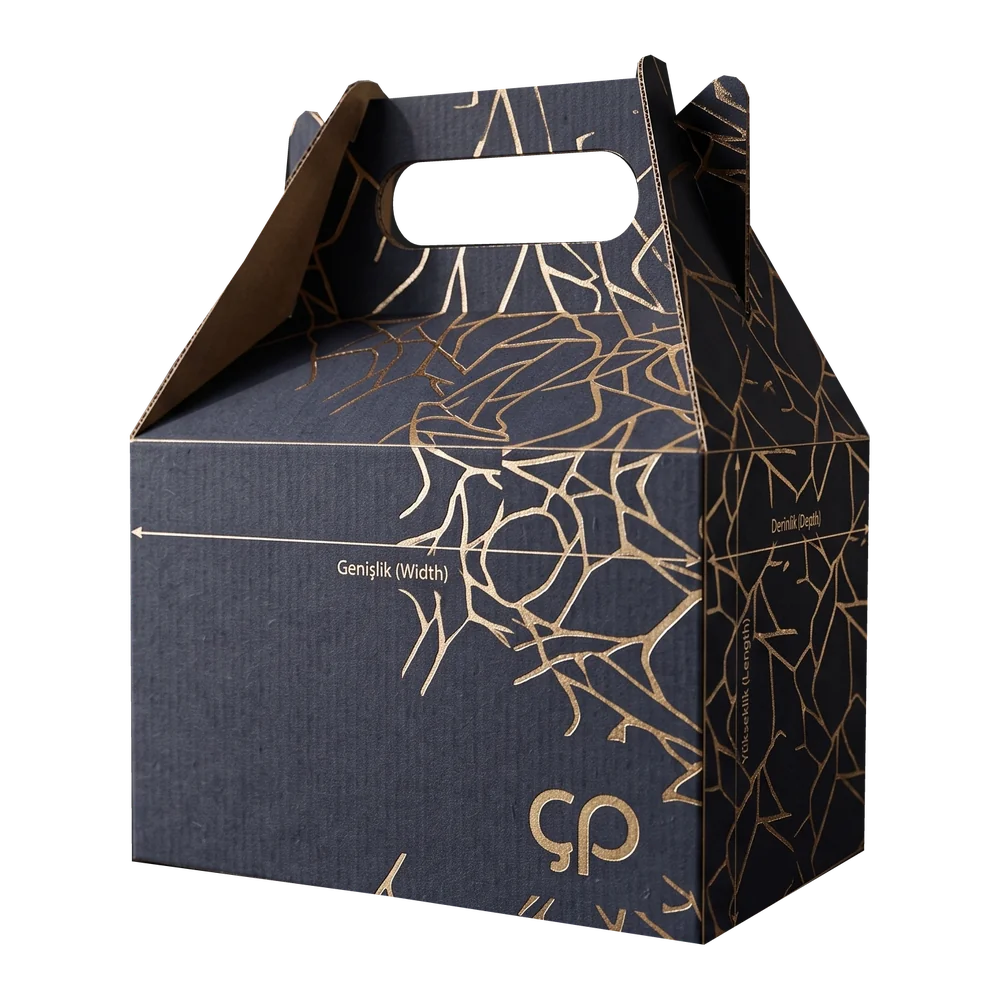
Box with Handle
| Selection | Quantity | Total Cost | Unit Cost |
|---|---|---|---|
100 Ad. | £195.44 | £1.954405 | |
250 Ad. | £227.43 | £0.909734 | |
500 Ad. | £280.76 | £0.561511 | |
1000 Ad. | £387.4 | £0.387399 | |
1500 Ad. | £494.04 | £0.329362 | |
2000 Ad. | £600.69 | £0.300343 | |
3000 Ad. | £813.97 | £0.271324 | |
4000 Ad. | £1027.26 | £0.256815 | |
5000 Ad. | £1240.55 | £0.248109 | |
8000 Ad. | £1887.66 | £0.235958 | |
10000 Ad. | £2321.49 | £0.232149 | |
20000 Ad. | £4490.63 | £0.224532 | |
40000 Ad. | £8828.92 | £0.220723 | |
50000 Ad. | £10998.06 | £0.219961 | |
100000 Ad. | £21843.78 | £0.218438 |
Box with Handle — Custom-Size Printed Carton Box with Carry Handle
Let Your Product Be Carried by Hand
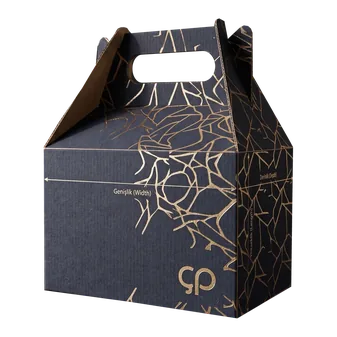
A box with handle is a one-piece carton pack whose two top panels meet like a roof around a finger opening, so it can be carried without a bag. From bakery goods and gift sets to event treats and takeaway, it works as both carrier bag and showcase wherever the product leaves the door with the customer. The customer who picks it up carries your brand down the street too; the handle and roof panels are the most visible print areas of the box. On this page we make your box to the size you set: you enter the dimensions, see the box in a 3D model instantly, choose carton or micro-flute material and printing, and read the price without waiting for a quote.
Why a Custom Size?
A stock-size box either squeezes the product or leaves empty space; in a box carried by hand that space means the product swings with every step. A box sized to the product gives you instead:
- The product stays put: the body fits the product, so nothing slides or tips over in transit; cakes, cookies or bottles stay in place.
- Balanced carrying: when the base is sized to the product, the box hangs evenly from the handle without leaning to one side.
- Less filling: with no wasted volume, you need less padding, fewer dividers and less shredded paper.
- A stronger brand experience: the two roof panels, the handle and the four side faces are print areas you can plan separately for logo, pattern and campaign message.
Design Your Box with Handle in 3D
Build the Handle, Roof and Locks on Screen Before Production
In a carry-handle pack, design errors show up mostly at the top: the logo lands on the finger opening, a roof fold splits the text in two, the lock tabs sit on the pattern. This page moves those decisions ahead of production. As soon as you enter the size, the box is built on screen as a real 3D model generated from the actual dieline for your dimensions and the thickness of the material you choose. Change the size or material and the roof, handle and locks are rebuilt together.
- Open and close the flaps: watch the roof panels and bottom flaps open in the model; see how the box closes and locks just as your customer will.
- Instant dieline: a die for your exact size is generated in seconds; download it free as PDF, SVG or PNG with cut and crease lines.
- Design, upload, view the mockup: place your artwork on the dieline and upload it to the page; watch the printed box as a three-dimensional mockup.
- Design with AI: give the downloaded dieline to an AI image tool, ask it to create artwork inside the die, then upload the result and review it in the 3D model right away.
Building the box on screen is faster and cheaper than waiting for a first sample. Whether the product fits, which panel carries the logo and how the handle meets the design are settled before production.
One-Piece Construction: Body, Roof and Handle
The box is cut from a single sheet: a body joined with a glue flap, roof panels that form the handle at the top and bottom flaps that close the base. Its key features:
- Roof-style top panels: two panels rising from the wide sides meet at the top to form the handle; triangular flaps on the narrow sides close the ends of the roof.
- Fixed-height handle: the handle stays about 5 cm high and the finger opening does not grow on larger boxes; the hand grips it equally well at every size.
- Locking closure: slots in the side flaps lock the handle panels together; the lock fits are recalculated for the box size and the thickness of the chosen material.
- Folding base: the bottom flaps fold inward to close the base; the product sits on a flat bottom and the box keeps its shape.
The height you enter is the body height; the roof and handle are not included. Remember to add them when planning the overall height. The fit of the locks and the feel of the handle are confirmed with a physical sample before series production.
How to Choose Carton or Micro-Flute Thickness?
In a Carried Box, Thickness Also Carries the Handle
In a box carried by hand, the whole weight of the product hangs from the handle; the material has to carry not only the walls but also the area around the finger opening and the locks. The first thing to know is that grammage is not the same as thickness. Grammage measures the weight of one square metre of board, while thickness depends on its bulk. Because coating compresses the surface, coated boards are heavy but thin, whereas bristol and multi-layer folding boxboard are clearly thicker at the same weight: 350 g/m² gloss coated board is 0.285 mm, bristol 0.49 mm. For heavier contents, micro-flute board places a fluted paper between two liners, thickening the section and giving far higher stiffness than carton.
Material Options and Thicknesses
We offer three carton families and two micro-flute options. The thickness of the material you choose feeds directly into the dieline and the 3D model; with micro-flute, the model also shows the flute section and a kraft inside.
| Material | Grammage / structure | Thickness | When to choose? |
|---|---|---|---|
| Coated board (gloss, matt, black, kraft surface) | 250–350 g/m² | 0.285 mm (gloss) · 0.358 mm (matt), 350 g/m² | Light products and photo-heavy boxes where saturated colour matters. |
| Bristol | 250–450 g/m² | 0.49 mm, 350 g/m² | The thickest carton at the same grammage; full, rigid-feeling gift and bakery boxes. |
| Folding boxboard (Normprint, Exprint, LuxTriplex) | 180–550 g/m² | 0.45 – 0.475 mm, 350 g/m² | Smooth print surface and high stiffness; a wide grammage range for medium-weight products. |
| Micro-flute — E flute | Single wall, very fine flute | 1.5 mm | Heavy or bulky products; much stiffer walls and handle than carton. |
| Micro-flute — B flute | Single wall | 3 mm | The heaviest contents such as bottles, jars and multi-item sets; the highest carrying strength. |
Black and kraft surfaces are also available in the coated family. These grounds have no white base under CMYK print, so light tones disappear and colours shift; designs with few colours and high contrast give better results.
Four Questions That Decide Thickness
The thickest material does not always make the best box; unnecessarily thick material adds both cost and weight. Answer these questions before deciding:
- How heavy is the product? for light contents such as cookies, cakes and small gifts, 300–350 g/m² carton is enough; for bottles, jars or multi-item sets the load on the handle and base grows, so micro-flute should be preferred.
- How big is the box? as the base grows, walls and roof panels flex more easily; on wide boxes bristol, folding boxboard or E flute keeps the shape.
- How long will it be carried? thin carton is enough for a short takeaway trip, while for long journeys, events or reusable gift boxes thicker material keeps the handle and locks from wearing.
- How important are print and surface feel? coated board stands out for photos and vivid colour, bristol for a full feel in the hand, and micro-flute when strength comes first.
You can read about paper types and grammage in the Paper Weight and Types Guide on our blog, and about flute types and strength in the Corrugated Board Guide.
Printing and Finishing Options
Every choice that shapes the look of your box is on one screen:
- Colour: print options from 2+0 to 5+1; the number after the plus shows printing on the inside of the board.
- Lamination: matt, gloss or soft-touch; it also protects the surface of a hand-carried box from scratches and stains.
- Varnish: spot, embossed, gloss, matt or satin varnish makes the logo and patterns on the roof panels stand out.
- Embossing and foil: emboss or deboss leaves an impression you can feel, and foil adds a metallic, premium brand detail.
Who Is a Box with Handle For?
For any business that wants to hand over its product with the convenience of carrying, this box type turns packaging into both a bag and a promotional tool. Its most common uses:
- Patisseries, bakeries and cafés: cakes, cupcakes, cookies and desserts; a tidy, branded handover without a bag.
- Takeaway and restaurants: meal and kids' meal boxes; the handle makes the box easy to carry in one hand.
- Events, birthdays and corporate treats: party favours, trade-show kits and guest packs; a strong first impression with the logo on the roof panels.
- Gift, cosmetics and delicatessen sets: sets presenting several products together; with micro-flute, bottles and jars travel safely too.
Recyclable Carton Packaging
Carton and corrugated board can be returned to the paper stream. Because the handle is cut from the box's own board, no plastic grip, string or separate carrier bag is needed; the pack is made of a single material, so no separation is needed for recycling either. A box sized to the product means less material and less filling.
Enter your size, open and close your box with handle in 3D, choose the material, download the dieline, prepare your artwork and upload it to see the mockup — you see the final box before you order.